Natural Creamy Peanut Butter Exporter & Supplier In Dubai
Dubai’s retail and foodservice markets serve shoppers who want convenient, protein-rich foods with simple ingredient lists. This creates opportunities for importers, supermarkets, cafés, bakeries, and private-label brands seeking natural peanut butter in retail or bulk formats.
Choosing a natural creamy peanut butter exporter to Dubai involves more than comparing prices. Buyers must review the recipe, taste, texture, food safety controls, packaging, shelf-life evidence, and export documents. NutriOneX Foods can be contacted to discuss product specifications and available export options for the Dubai market.
What Dubai Peanut Butter Buyers Look For

Clean Label Formulation and Natural Ingredients
Natural peanut butter can have several formulations. Some recipes contain only roasted peanuts, while others include salt, sweeteners, or stabilizing ingredients. Buyers should define the required recipe before requesting samples or quotations.
The word “natural” does not always mean that a product is sugar-free, salt-free, or made with 100% peanuts. Claims such as no added preservatives must match the actual formulation. A clear product specification helps buyers compare recipes and avoid confusion during label development.
Protein-Rich Spreads for Modern Consumers
A protein rich spread can fit several eating occasions. Consumers may add peanut butter to toast, sandwiches, oatmeal, smoothies, sauces, bakery products, or desserts. Retailers can also position it as a convenient breakfast or snack option without making unsupported health claims.
The right recipe depends on the intended customer. A fitness-focused brand may prefer a short ingredient list, while a family product may focus on easy spreading and mild flavor. Foodservice buyers may place greater value on viscosity and portion control.
Products for Different Dubai Sales Channels
Requirements vary across supermarkets, specialty stores, online retailers, hotels, cafes, and catering businesses. For example, peanut butter for supermarkets needs strong shelf appeal and consumer-friendly labeling. A bakery may prefer larger containers and reliable consistency for repeat recipes.
Private-label buyers should also consider how the formulation supports their brand position. Ingredient claims, nutrition details, serving suggestions, and packaging language should all be checked before production.
What Makes Peanut Butter Smooth and Creamy?
Roasted Peanuts and Flavor Development
The quality of roasted peanuts has a direct effect on flavor, aroma, and color. Peanut variety, grading, freshness, and roast level can create a mild taste or a deeper roasted profile. Consistent roasting also helps prevent raw, bitter, or burnt notes.
Raw material controls are equally important. Commercial buyers should ask how peanuts are inspected, stored, and traced. They should also review relevant aflatoxin testing because careful sourcing and monitoring are key considerations for peanut products.
Grinding and Creamy Texture
Grinding reduces the peanuts to a fine paste and releases their natural oils. Particle size affects mouthfeel, spreadability, and the final creamy texture. A well-defined process helps produce a smooth peanut spread that performs as expected throughout its stated shelf life.
There is no single ideal texture for every buyer. Retail customers may want a soft spread that is easy to use straight from the jar. Bakeries may need a thicker product that holds its shape in fillings. Samples should therefore be tested in the intended application.
Why Does Natural Peanut Butter Separate?
Peanut oil separation is common in products made with few or no stabilizing ingredients. Natural oil can rise to the top while peanut solids settle below. This does not automatically mean that the product is spoiled.
Formulation, particle size, processing, storage time, and temperature can all influence separation. Where appropriate, the label may advise consumers to stir before use. Buyers should review this behavior during product trials, especially when products may face warm storage or transit conditions.
Does Natural Peanut Butter Need Preservatives?
There is no universal answer. Product safety and shelf life depend on the recipe, hygienic processing, packaging, and storage conditions. Preservatives and stabilizers also perform different roles. A stabilizer may help manage consistency and texture without serving as a preservative.
Any shelf-life claim should come from testing of the specific product and pack. Buyers should not rely on a generic timeframe taken from another recipe.
Retail and Foodservice Packaging Formats
Peanut Butter for Retail
Retail jar packaging should protect the product while making it easy to store and use. Buyers may need tamper evidence, secure closures, batch coding, barcodes, readable labels, and durable outer cartons. The complete pack should also withstand handling during shipping and distribution.
Peanut butter for retail may be offered in different net weights based on customer demand. Actual sizes, materials, closures, and carton configurations should be confirmed with the supplier before label artwork begins.
Natural Peanut Butter for Foodservice
Hotels, restaurants, cafes, bakeries, and caterers often require bulk food packaging. Larger food-grade containers can reduce the cost per serving and make commercial preparation more efficient. However, the pack must still be easy to open, handle, reseal, and store.
Buyers seeking natural peanut butter for foodservice should specify expected usage, viscosity, pack size, kitchen conditions, and storage practices. Testing the product in recipes can confirm whether it delivers the required flavor and performance.
How to Choose a Pack Format
- Supermarkets: Focus on shelf appeal, convenient sizing, tamper evidence, and clear labeling.
- E-commerce sellers: Prioritize leak resistance, closure strength, and shipping durability.
- Bakeries and cafés: Consider bulk packs, easy portioning, and consistent viscosity.
- Private-label brands: Review branding space, differentiation, artwork approval, and carton needs.
How to Evaluate a Peanut Butter Export Supplier

Review Food Safety and Quality Systems
A supplier should be able to explain how food safety is managed from raw peanut intake to final packing. Buyers can request relevant evidence rather than relying on broad statements such as “premium quality.”
- Food safety certifications applicable to the facility
- HACCP-based controls and allergen procedures
- Traceability and product recall systems
- Sanitation and pest-control programs
- Batch testing records and Certificates of Analysis, where applicable
- Finished product and packaging specifications
Peanuts are a major allergen, so accurate declaration and cross-contact controls are essential. Certification status and scope should always be verified directly with the company.
Check Aflatoxin and Microbiological Controls
Aflatoxin monitoring is an important part of peanut sourcing. Importers should review the supplier’s specifications, testing frequency, sampling process, and laboratory documents. Testing requirements may depend on the destination, product, buyer policy, and current regulations.
Peanut butter is a low-moisture food, but that does not remove every microbiological risk. Buyers should ask how the facility controls hazards such as Salmonella through supplier approval, processing, sanitation, environmental controls, and product testing.
Confirm Batch-to-Batch Consistency
A commercial sample should become a clear benchmark for future supply. The agreed specification may cover roast color, flavor, particle size, viscosity, spreadability, oil separation, fill weight, seal integrity, and shelf life stability.
Samples should be tested after storage as well as when freshly produced. This gives buyers a better view of how the product may change over time.
What Documents Should an Importer Request?
- Product specification and ingredient statement
- Allergen declaration and nutrition information
- Certificate of Analysis, where required
- Shelf-life and recommended storage information
- Country-of-origin documents
- Commercial invoice and packing list
- Relevant health, export, or conformity documents
- Manufacturing, expiry, lot, and batch details
Dubai Labeling and Import Considerations
Product Registration and Label Review
Imported food may require product registration and label review before it can be sold in Dubai. The importer should confirm the current process with Dubai Municipality and other relevant UAE authorities before shipment.
Labels may need to show the product name, ingredients, nutrition information, net quantity, country of origin, manufacturer or packer details, storage instructions, and production and expiry dates. Lot identification and a clear peanut allergen declaration may also be required.
Arabic labeling requirements should be checked during artwork development. This list is general guidance, not legal advice. The importer of record should verify all current rules for the specific product.
Food-Grade Packaging for Dubai’s Climate
Warm conditions can affect oxidation, texture, label adhesion, seal integrity, and oil movement. Food grade packaging should therefore be assessed as a complete system rather than as a jar alone.
Buyers should review the container, closure, liner, induction seal, label, carton, and pallet arrangement. Transit trials can help identify leaks, dents, loose lids, or damaged cartons before a larger order is shipped.
How Long Does Natural Peanut Butter Last?
Shelf life depends on ingredients, processing, oxygen exposure, packaging, and storage. A stabilized product may behave differently from a recipe made only with peanuts. For that reason, buyers should request product-specific stability evidence.
Instructions after opening may also differ from unopened storage guidance. Refrigeration can change spreadability, so any direction should be based on the approved recipe and validated product information.
Private Label Peanut Butter and Export Process
Private Label Product Development
A private label peanut butter project may involve choices such as smooth or extra-smooth texture, salted or unsalted recipes, and sweetened or unsweetened options. Buyers may also compare stabilized and non-stabilized formulations.
Available recipes, claims, pack sizes, and customization options depend on manufacturing capability and regulatory approval. Brand owners should confirm who is responsible for artwork, label checks, barcode creation, testing, and final approval.
From Sample Approval to Shipment
- The buyer shares the desired recipe, application, pack size, and sales channel.
- The supplier confirms available options, minimum order quantity, price, and lead time.
- Samples and technical documents are reviewed.
- The buyer or importer checks label artwork and local compliance.
- Commercial production and agreed quality tests are completed.
- Products are packed and shipment documents are prepared.
- Goods are dispatched under the agreed Incoterms.
- The importer handles local clearance and distribution.
Questions to Ask Before Ordering
- What is the minimum order quantity for each SKU?
- What are the production and shipping lead times?
- Which Incoterms and shipment methods are available?
- How is the stated shelf life validated?
- Which tests are completed for each batch?
- Are retained samples kept?
- How are complaints, non-conformities, and recalls managed?
Why Source Natural Peanut Butter from India?
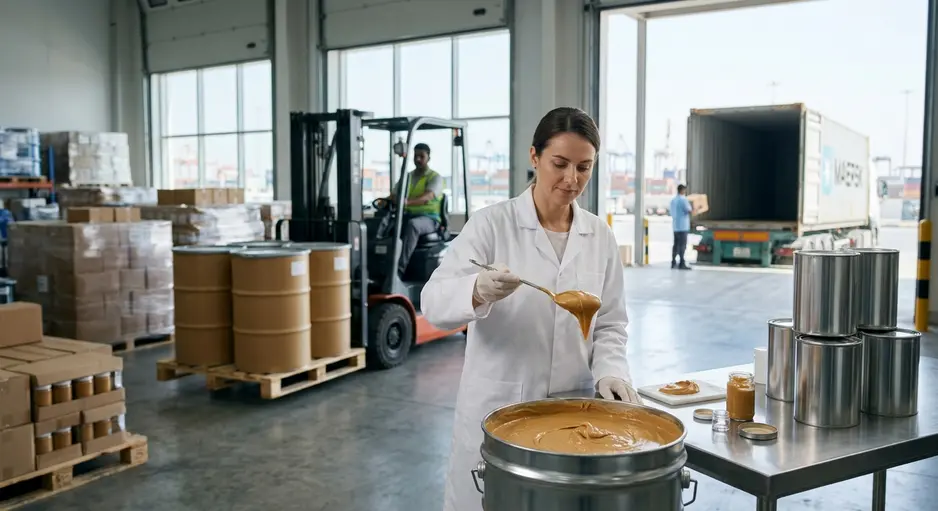
India has an established peanut-processing sector and access to peanut-producing regions. Yet country of origin alone does not prove quality. Buyers should evaluate each supplier’s traceability, raw material controls, testing, production capacity, packaging systems, and communication.
When choosing a natural peanut butter exporter from India, importers should also compare document readiness and private-label support. Clear responses during sampling often provide useful insight into how the supplier may handle future orders or quality concerns.
Working With Nutrionex Foods
Dubai importers, distributors, supermarket buyers, foodservice operators, and private-label brands can contact NutriOneX Foods to discuss natural creamy peanut butter specifications, packaging formats, minimum order quantities, documentation, lead times, and export terms.
Buyers searching for a natural creamy peanut butter supplier in Dubai should confirm whether supply will be managed through direct import, a local distributor, or another agreed route. Request written product and commercial details before placing an order.
Natural Creamy Peanut Butter Exporter & Supplier in Dubai
Choose a Supplier With Clear Product Evidence
A dependable sourcing decision starts with a defined recipe and measurable requirements. Taste is important, but buyers must also examine food safety, texture, oil separation, packaging performance, label compliance, and export documentation.
If you are looking for a peanut butter export company to Dubai, contact Nutrionex Foods to request product specifications, samples, available packaging formats, private-label options, minimum order quantities, lead times, export documents, and a customized quotation.
Frequently Asked Questions
Who supplies natural creamy peanut butter in Dubai?
Buyers can source through local distributors or work with an export-ready producer. Evaluate the product specification, food safety documents, packaging, shelf-life evidence, import support, lead time, and total landed cost rather than price alone.
1. Can natural peanut butter be supplied under a private label?
Private-label supply may be available depending on the producer’s capabilities, minimum order quantity, recipes, and packaging options. Confirm artwork responsibilities, label approval, product testing, recipe ownership, and delivery schedules before starting the project.
2. Why does oil collect on top of natural peanut butter?
Natural peanut oil may rise when the recipe contains few or no stabilizing ingredients. Stirring often restores an even texture. Consumers should still follow the label’s storage guidance and check the product if its seal, smell, or appearance seems unusual.
3. Is natural peanut butter suitable for supermarkets?
Yes, provided it has compliant labeling, durable retail packaging, suitable barcodes, consistent quality, supported shelf life, and the documents or registrations required for sale in the destination market.
4. Is bulk peanut butter available for foodservice?
Bulk formats may be suitable for bakeries, hotels, cafés, caterers, and commercial kitchens. Buyers should specify the required recipe, viscosity, container size, monthly demand, storage conditions, and intended use when requesting a quotation.
5. What should buyers check before importing to Dubai?
Check ingredient compliance, allergen declarations, Arabic label needs, product registration, stability documents, food-grade packs, quality records, and shipping documents. Confirm current clearance requirements with the importer of record and the relevant UAE authorities.